
What Is a Go-to-Market (GTM) Strategy?
 Rishabh Jain
TL;DR
A go-to-market (GTM) strategy is the action plan that connects your product with its ideal customers. It defines who you’re selling to, why they should care, and how you’ll reach them faster than competitors.
A strong GTM strategy aligns product, marketing, sales, and customer success around one shared goal, getting your product into the market efficiently and profitably. It blends market research, customer insights, and data-driven experimentation to identify the best message, price, and channel mix for launch.
The best GTM plans are repeatable systems, not one-off campaigns. They’re tested, measured, and refined continuously, so you double down on what drives growth and drop what doesn’t.
In short: research, launch, learn, repeat, that’s how winning GTM strategies scale.
What Is a Go-to-Market Strategy?
A go-to-market (GTM) strategy is a structured roadmap that outlines how a company will introduce a product or service to a specific market segment — and do it profitably. It defines your target audience, clarifies your value proposition, and determines the best channels to reach, convert, and retain customers.
The purpose of a GTM strategy is to reduce launch risk, accelerate time-to-revenue, and align teams across product, marketing, and sales toward a single, measurable growth outcome.
You typically need a GTM strategy when:
Launching a new product or feature
Entering a new market or segment
Repositioning your brand or product
Expanding into a new region or demographic
Rolling out a new pricing or packaging model
A good GTM removes guesswork from growth. It clarifies who you serve, why you win, and how you’ll capture demand—profitably.
GTM vs. Marketing Strategy vs. Launch Plan
It’s easy to confuse go-to-market, marketing, and launch strategies — but each plays a distinct role in how your business brings products to customers.
Go-to-Market (GTM) Strategy: A cross-functional blueprint that connects your Ideal Customer Profile (ICP), pricing, sales enablement, distribution channels, and revenue operations. It defines how your entire company approaches market entry and customer acquisition.
Marketing Strategy: A long-term growth engine focused on brand awareness, lead generation, and demand creation across markets and segments. It supports your GTM by building audience trust and consistent engagement.
Launch Plan: A time-bound tactical plan that sits within your GTM — detailing campaigns, timelines, messaging, and deliverables for a specific product or feature rollout.
Core Components (The 4 Ps + 1 People)
A strong go-to-market (GTM) strategy rests on five essential pillars — the traditional 4 Ps of marketing, plus a fifth: People. Together, these components form a repeatable system that helps companies capture demand, scale efficiently, and deliver consistent value.
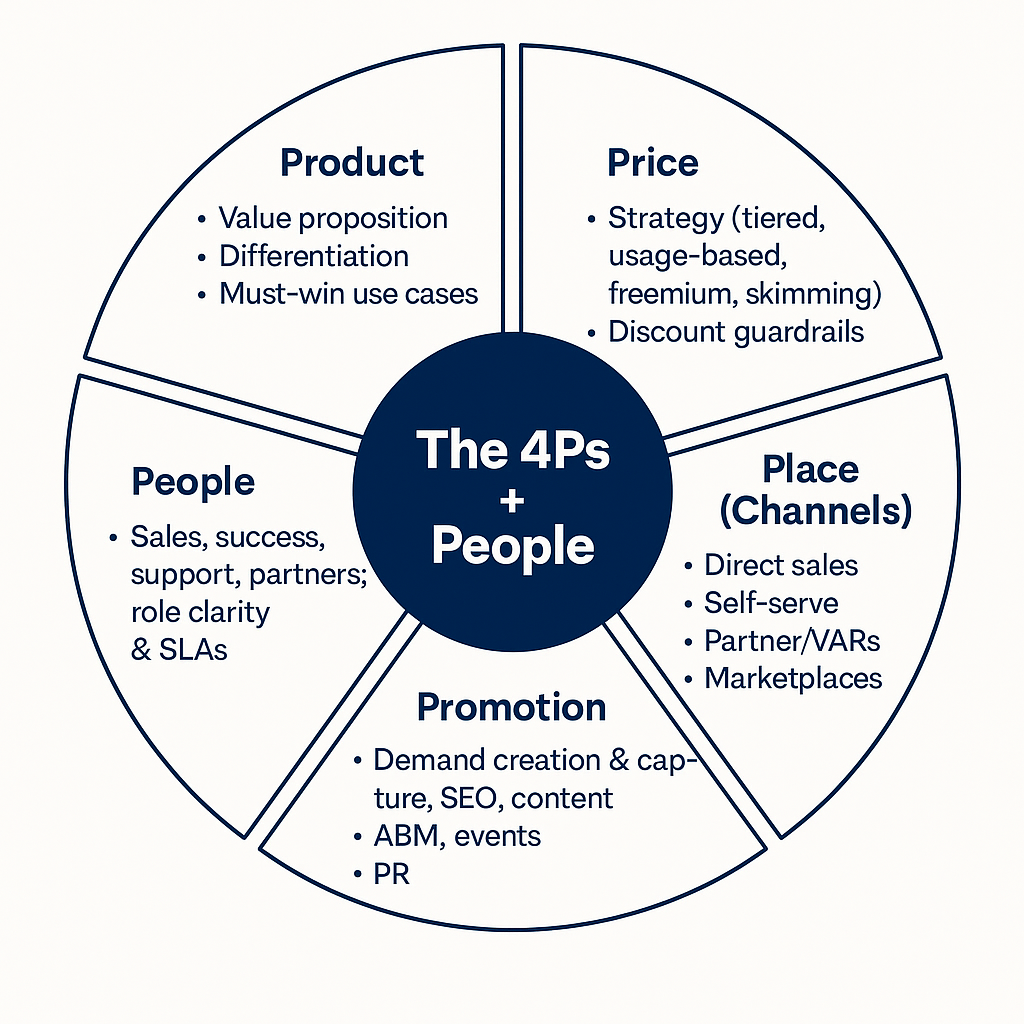
Product
Define your value proposition, core use cases, and competitive differentiation. Clearly articulate what problem your product solves and why it’s the best solution in your category.
Example: HubSpot built its GTM on a simple proposition — helping businesses grow through inbound marketing, making its value tangible from the first interaction.
Price
Select a pricing model that reflects perceived value and aligns with customer willingness to pay. Options include tiered, usage-based, freemium, and premium/skimming models. Establish discount guidelines and margin thresholds to maintain profitability while staying competitive.
Place (Channels)
Identify the most effective distribution paths — direct sales, self-serve platforms, partner or VAR networks, or digital marketplaces. Each channel demands specific enablement, messaging, and measurement frameworks.
For instance, Slack combined self-serve onboarding with enterprise sales to expand across both SMB and corporate segments.
Promotion
Develop a balanced plan for both demand creation and demand capture. Tactics include content marketing, SEO, ABM, paid acquisition, PR, and events. The goal is to guide prospects seamlessly from awareness and interest to intent and conversion.
People
Align internal teams — sales, marketing, customer success, and partnerships — under shared goals and service-level agreements. Define accountability for each stage of the customer journey and create a closed feedback loop to optimize performance over time.
GTM Strategy Framework (Step-by-Step Playbook)
A well-defined go-to-market strategy framework connects every moving part of your business — from market insight to customer retention — into a measurable, repeatable system. Below is a 9-step GTM playbook you can apply across product launches, market expansions, or repositioning efforts.
1) Market & Customer Research
Start with data, not assumptions.
Analyze TAM/SAM/SOM to size your market, run competitor SWOT analyses, and identify emerging demand signals. Map pricing power by segment and region.
Develop an ICP and persona stack — including the economic buyer, champion, and end user — to align outreach and messaging.
2) Positioning & Messaging
Define your category, unique point of view, and value pillars. Support each with social proof, testimonials, or case studies.
Create a messaging matrix by persona and funnel stage (awareness → decision) to ensure tone and proof evolve with intent.
3) GTM Motions & Model
Decide which GTM motion drives growth:
Sales-led: relationship-driven, high-touch
Product-led (PLG): freemium or self-serve adoption
Community-led: credibility through advocates
Channel-led: leverage resellers or VARs
Hybrid: mix of inbound and outbound
Match the motion to your ACV, sales cycle, and buyer behavior.
4) Pricing & Packaging
Select a pricing model that fits your customer segment — flat-rate, tiered, per-user, per-feature, or usage-based.
Incorporate free trials or freemium plans for PLG models, and establish discount approval policies to protect margin integrity.
5) Route-to-Market & Channel Strategy
Choose distribution paths — direct, self-serve, partner/VAR, or marketplace (AWS, AppExchange).
Support partners with MDF programs, enablement kits, and co-branded content. Build partner certifications to ensure consistent customer experience.
6) Demand Strategy (Create + Capture)
Create demand: through category storytelling, events, and thought leadership.
Capture demand: using SEO clusters, review platforms, retargeting, and intent data.
Architect campaigns for every layer — launch, evergreen, ABM, and lifecycle.
7) Sales GTM & Enablement
Build your sales motion with clarity and structure: define territories, roles, and comp plans.
Use qualification frameworks like MEDDICC or BANT, and design sales playbooks with objection handling, call frameworks, and demo flows that align with buyer intent.
8) Success & Retention Plan
Retention is part of your GTM.
Implement structured onboarding, track activation milestones, and schedule QBRs to uncover upsell opportunities.
Measure NRR/GRR, track expansion rates, and design customer advocacy programs.
9) Measurement & Governance
Set clear north-star metrics (pipeline, CAC payback, win rate) and define leading indicators for proactive adjustments.
Maintain a weekly GTM stand-up and retro cadence to track experiments, learnings, and performance.
GTM Models & When to Use Them
Not every product — or market — fits the same motion. The right GTM model depends on deal size, customer behavior, and buying complexity.
Use this quick decision table to align your approach with your product’s economics and target audience.
Model | Best For | Key Traits | When to Use |
|---|---|---|---|
Sales-Led | Enterprise / high-ACV products | Multi-touch process, demos, stakeholder consensus | When deals involve multiple decision-makers or compliance-heavy cycles. |
Product-Led (PLG) | SaaS, SMB, or freemium tools | Self-serve onboarding, in-app trials, viral loops | When your product can sell itself through experience or usage-based pricing. |
Channel-Led | Regional or industry-specific solutions | Partner ecosystems, VARs, resellers, co-marketing | When expanding to new geographies or verticals without large internal teams. |
Hybrid | B2B SaaS scale-ups | Combines PLG efficiency + sales-led depth | When transitioning from product adoption to enterprise expansion. |
How to Build a Go-to-Market Plan (With Examples)
Every GTM plan should define how your product reaches customers, converts interest into revenue, and scales sustainably.
Below are three real-world GTM examples that illustrate different approaches based on product type and market fit.
Example 1: B2B SaaS — Product-Led Growth (PLG) + Sales Assist
Motion: Start with a freemium or trial-based model to attract users organically, then layer in sales once product value is proven.
Free tier → in-app activation → Product-Qualified Lead (PQL) → AE handoff.
Focus on usage signals, not lead forms, to trigger outreach.
Works best for: SaaS tools, productivity platforms, SMB software.
Example 2: Enterprise Cybersecurity — Sales-Led Motion
Motion: Targeted, account-based approach that prioritizes trust, credibility, and multi-stakeholder validation.
ABM + outbound prospecting → Field marketing → Pilot or proof-of-value → Enterprise rollout.
Key success factors: ROI justification and security compliance wins.
Works best for: Enterprise tech, cybersecurity, or compliance-heavy B2B.
Example 3: Retail Hardware — Channel-Led Approach
Motion: Build partnerships to expand distribution and local market reach efficiently.
Distributors → Retail pricing strategy → Co-op advertising with resellers.
Focus on channel enablement kits, MDF (marketing development funds), and sales incentives.
Works best for: Hardware, consumer electronics, and IoT devices.
GTM Launch Checklist (Operational)
Before you hit “launch,” ensure every function — from marketing to sales to success — is aligned, equipped, and ready.
Use this operational GTM checklist to guarantee a smooth rollout and fast adoption.
Stage | Task | Purpose |
|---|---|---|
1. Final ICP & Persona Sign-Off | Confirm Ideal Customer Profile and decision-maker personas. | Ensures message-market fit before launch. |
2. Pricing & Legal Approvals | Finalize pricing tiers, contracts, SLAs, and regional compliance. | Avoids post-launch friction with customers or partners. |
3. Sales Enablement Kit | Prepare updated deck, demo script, FAQs, and objection-handling playbooks. | Keeps the entire GTM team consistent and confident. |
4. Campaign Assets Live | Activate SEO pages, paid ads, email nurtures, social posts, and press releases. | Drives awareness and demand from Day 1. |
5. Success Playbooks | Align onboarding steps, customer support flows, and retention triggers. | Converts early customers into long-term advocates. |
Pro Tip: Treat your GTM launch like a product sprint — run daily stand-ups across marketing, sales, and CS for the first 30 days.
KPIs for a GTM Strategy (Dashboard)
A great GTM strategy isn’t complete without a clear view of performance.
These core GTM metrics help you track acquisition efficiency, conversion health, and long-term revenue impact.
Category | Key Metrics | What It Tells You |
|---|---|---|
Acquisition | MQL→SQL rate, SQO (Sales Qualified Opportunities), Pipeline coverage, CAC, Payback period | How effectively your GTM drives qualified demand and ROI. |
Conversion | Demo-to-win rate, Sales cycle length, Win/Loss reasons | Whether messaging, enablement, and pricing resonate with buyers. |
Revenue Quality | ACV (Average Contract Value), NRR (Net Revenue Retention), GRR (Gross Revenue Retention), Expansion mix | The sustainability and profitability of acquired customers. |
Efficiency | Lead velocity rate, Partner-sourced %, Cost per opportunity | Speed and leverage of your go-to-market engine. |
Tools & Templates for GTM (2026 Stack)
A strong go-to-market engine runs on the right tech stack.
Here’s a curated GTM toolset for 2026 that aligns data, content, and sales execution across every stage of your launch.
Category | Top Tools | Use Case |
|---|---|---|
CRM & RevOps | Salesforce, HubSpot | Track leads, pipeline, and deal velocity across GTM stages. |
Attribution & Analytics | Factors.ai, Dreamdata | Measure channel performance, ROI, and multi-touch influence. |
Content & SEO | Ahrefs, Clearscope | Optimize content strategy and rank for high-intent GTM keywords. |
PLG & Product Analytics | Pendo, Amplitude | Track in-app behavior, product adoption, and activation metrics. |
Sales Enablement & Sequences | SalesEcho, Outreach | Automate personalized outreach, follow-ups, and GTM sequences. |
Project Management | Asana, Notion | Coordinate launch timelines, cross-functional tasks, and reporting. |
Related
Best AI Sales Intelligence Tools
Common GTM Mistakes (and How to Avoid Them)
Even the best GTM plans can fail if execution drifts from focus and feedback.
Here are the most frequent go-to-market mistakes — and how to fix them before they slow your growth.
Mistake | Why It Happens | How to Fix It |
|---|---|---|
Too Broad ICP | Targeting everyone instead of the most profitable segments. | Narrow your focus to the highest LTV and lowest CAC customer cohort. |
Message ≠ Market | Assumptions replace real customer insights. | Conduct customer interviews and win/loss analysis to refine messaging. |
Channel Sprawl | Testing too many channels too soon. | Double down on 2–3 scalable GTM motions that match your ICP. |
No Pricing Strategy | Reactive pricing or copying competitors. | Run pricing experiments tied to measurable value metrics. |
No Post-Launch Iteration | Treating GTM as a one-time event. | Set weekly retros to track data, feedback, and next-step experiments. |
Go-to-Market for Startups (Fast-Track)
Startups don’t need a perfect GTM plan — they need one that learns fast.
Here’s how early-stage teams can validate demand, win early adopters, and build momentum efficiently.
1. Beachhead First (Bowling-Pin Strategy)
Focus on one must-win niche that can unlock adjacent markets later.
Early traction in a single use case creates social proof and data for expansion.
2. Offer-Market Test (30–45 Days)
Launch a lightweight validation loop — a landing page, sales script, and quick outreach to test response.
The goal: confirm problem-solution fit before scaling channels or spend.
3. Founder-Led Sales Before Hiring
Early customers buy into founders, not playbooks.
Founders should own the first 50–100 sales calls to refine pitch, objections, and ICP insights.
4. Lightweight Stack & Metrics Discipline
Use a lean stack (HubSpot Starter, SalesEcho, Notion) and track:
CAC Payback: How fast you recover your acquisition cost.
LTV:CAC Ratio: Aim for at least 3:1 for sustainable growth.
Industry-Specific GTM Playbooks
Every industry demands a tailored GTM motion.
While core principles stay the same — ICP clarity, positioning, and measurement — execution must fit the buying environment and channel dynamics.
Industry | Winning GTM Model | Core Focus Areas |
|---|---|---|
B2B SaaS | PLG + Sales-Assist + ABM Hybrid | Leverage self-serve activation for SMBs while layering ABM for enterprise. Prioritize user onboarding, product education, and usage-based pricing. |
Fintech | Compliance-Led & Trust-Centric | Emphasize security, regulation, and credibility. Build credibility through licenses, partner ecosystems, and transparent communication. |
Retail / eCommerce | Omnichannel & Marketplace-Driven | Combine direct-to-consumer with marketplace optimization. Use retail media, influencer partnerships, and loyalty loops. |
Manufacturing | Channel & Distribution-Led | Build around distributors, trade shows, and RFQs. Focus on relationships, long sales cycles, and technical product documentation. |
FAQs
1. What is a go-to-market (GTM) strategy?
A GTM strategy is the roadmap that defines how your company will introduce a product to the market, attract customers, and achieve predictable growth. It covers research, positioning, pricing, and sales execution.
2. How is a GTM strategy different from a marketing strategy?
Marketing strategy focuses on long-term brand awareness and demand generation.
A GTM strategy focuses on short- to mid-term revenue outcomes — how you’ll reach the market, win customers, and scale efficiently.
3. When should a company create a go-to-market plan?
You need a GTM strategy when launching a new product, entering a new market, or repositioning your brand for a new segment or pricing model.
4. What are the key elements of a GTM framework?
Research & ICP definition, positioning & messaging, pricing, channel selection, enablement, and measurement. Every GTM connects these into a repeatable system.
5. What metrics define a successful GTM?
CAC payback, LTV:CAC ratio, win rate, pipeline velocity, and NRR (Net Revenue Retention). These measure both efficiency and quality of growth.
6. What are the most common GTM mistakes?
Overly broad ICPs, unclear messaging, scattered channels, reactive pricing, and lack of iteration after launch.
7. How can startups build a fast, low-cost GTM strategy?
Start with a single “beachhead” market, run quick validation loops (landing page + outreach), and focus on founder-led sales before scaling.
8. What tools help with GTM planning and execution?
Salesforce, HubSpot, SalesEcho, Factors.ai, Ahrefs, Clearscope, Pendo, and Notion are top picks for CRM, analytics, SEO, and coordination.
Conclusion: Turning GTM Into a Growth System
A strong go-to-market strategy isn’t a one-time launch plan — it’s a living system that learns, iterates, and compounds.
The most successful teams treat GTM as a cross-functional discipline, uniting marketing, sales, product, and success around one shared metric: revenue efficiency.
Whether you’re launching a SaaS platform or scaling a B2B solution, remember:
Clarity beats complexity. Consistency beats intensity.
The right GTM doesn’t just take you to market — it keeps you winning in it.