
What Is B2B Sales? Definition, Process, Strategies, and 2026 Playbooks
 Rishabh Jain
TL;DR
B2B sales refers to one business selling goods or services to another. Unlike B2C, deals are typically larger, sales cycles are longer, and purchasing decisions involve multiple stakeholders, formal evaluations, and layers of internal approvals.
Winning in 2026 requires adopting a hybrid sales motion that blends inbound, outbound, partner, and product-led sales strategies. Top teams focus on multithreading deals, enabling internal champions with consensus-building assets, and measuring what actually matters:
Pipeline creation
Win rate
Sales cycle length
Average Selling Price (ASP)
Forecast accuracy
Net Revenue Retention (NRR)
This guide goes beyond surface definitions. It includes everything the top-ranking pages cover — plus what they miss:
Copy-paste playbooks for real sales execution
Legal and security checklists to speed up procurement cycles
Deal desk / CPQ frameworks to standardize commercial approvals
Digital Sales Room (DSR) best practices to align stakeholders
AI-assisted workflows to increase rep productivity
Sales-side KPI dashboards to run a data-driven revenue engine
In short, this article gives you a complete, modern B2B sales playbook — not just a definition.
What is B2B Sales?
B2B sales is the process of selling products or services from one business to another, typically involving higher contract values, multiple decision-makers, and longer sales cycles with structured demos, negotiations, legal/security reviews, and multi-stage approvals. Unlike B2C, which focuses on individual consumers and fast decisions, B2B sales requires navigating buying committees and proving both financial and operational value.
One-Sentence Definition
B2B sales is the coordinated use of channels, content, and data to identify, engage, and convert buying committees at other organizations into revenue.
Examples:
A SaaS company selling financial software to IT, finance, and operations teams at mid-market enterprises.
An industrial supplier providing components to manufacturers through negotiated contracts.
An agency selling retainer-based marketing services to large enterprise marketing departments.
B2B vs. B2C at a Glance
While both involve selling products or services, B2B (business-to-business) and B2C (business-to-consumer) sales operate on fundamentally different dynamics. The table below breaks down the core differences.
Factor | B2B Sales | B2C Sales |
|---|---|---|
Who Buys | Buying committees with multiple stakeholders, departmental approvals, and budget sign-offs | Individuals or households making personal purchasing decisions |
Sales Cycle | Weeks to months, involving structured evaluation, demos, legal/security reviews, and procurement | Hours to weeks, typically fast and emotionally driven |
Proof Required | ROI calculations, integration plans, compliance checks, scalability, and risk mitigation | Emotional appeal, convenience, peer reviews, and immediate value |
Sales Motion | Sales-assisted + self-serve hybrid, often using inbound, outbound, partner, and product-led motions | Primarily self-serve through eCommerce, retail, or digital channels |
Post-Sale Focus | Land-and-expand, renewals, upsells, and Net Revenue Retention (NRR) | Loyalty, repeat purchases, referrals, and community advocacy |
Mobile-Friendly Summary (List Format)
Who buys: Committees with approvals vs. individuals.
Cycle: Weeks–months with formal evaluation vs. days/weeks.
Proof required: ROI, integration, compliance vs. emotion, convenience.
Motion: Sales-assisted + self-serve hybrid vs. mostly self-serve.
Post-sale: Land-expand, renewals, NRR vs. loyalty/repurchase.
The Modern B2B Sales Motions (Choose Your Mix)
In 2026, winning B2B sales teams don’t rely on a single approach — they build hybrid motions that match how buyers actually behave. Modern buying journeys involve a mix of self-serve research, marketing influence, sales engagement, and partner ecosystems. The key is to pick the one or two core motions you can execute with excellence, then layer others strategically once your process is repeatable.
Inbound (Marketing-Led)
Inbound sales motions are powered by buyers coming to you through educational content, search, and digital touchpoints. Marketing attracts and nurtures interest, and sales steps in when buyers are ready for deeper conversations.
Typical Flow:
Content → Demo or free trial → Sales-assist
Strengths:
Scales well through SEO, SEM, and content distribution
Attracts high-intent leads already problem-aware
Ideal for SaaS and mid-market segments where buyers prefer to self-educate first
Key Assets:
Pricing pages with clear tiers and CTA paths
“X vs Y” competitor comparison pages to capture evaluation-stage intent
“Alternatives to [Competitor]” content for buyers switching solutions
Integration and security pages to satisfy IT/legal checks early
Review site presence (e.g., G2, TrustRadius) to build social proof
Outbound (Sales-Led)
Outbound sales relies on proactive outreach to targeted accounts. Instead of waiting for buyers to find you, your team identifies ICP-fit prospects, builds context, and opens conversations through personalized outreach and multithreaded sequences.
Tactics:
Curated ICP lists and buying group identification
Intent signals from search, ABM platforms, partner ecosystems
Multi-channel sequencing (email, LinkedIn, phone, video)
Social selling to build credibility before outreach
Typical Playbook:
Research: Account + buying group mapping
Pattern-Break Opener: Personalized insight, hook, or POV that stands out
Value Proof: Show why the conversation matters (ROI, competitive insight, business case)
Meeting: Land a qualified discovery call and build a mutual action plan
Best For: Enterprise deals, strategic accounts, or breaking into new segments where inbound volume is limited.
Partner / Channel
Partner and channel motions leverage third-party ecosystems — other vendors, resellers, agencies, or marketplaces — to reach in-market buyers more efficiently. Instead of generating demand from scratch, you attach to existing demand through co-selling and trusted networks.
Tactics:
Co-selling with technology or services partners to win deals together
Referrals from ecosystem partners, VARs, or agencies
Marketplace listings (e.g., AWS, Salesforce, HubSpot) to intercept active buyers
Joint events, webinars, or case studies to extend reach
Strengths:
Higher conversion rates through trusted introductions
Opens access to markets you can’t reach alone
Scales efficiently once partner processes and attribution are defined
Product-Led Sales (PLS)
Product-Led Sales blends self-serve product experiences with timely human engagement. Prospects sign up, explore the product, and hit defined usage milestones that trigger AE involvement. Sales steps in with real data about what the buyer has done, not just what they’ve said.
Typical Flow:
Self-serve sign-up → Product usage milestones → AE engagement → Mutual Action Plan
Key Elements:
Free trial or freemium experience that drives initial adoption
Defined product signals (e.g., number of active users, integrations, feature usage) that indicate buying readiness
Sales outreach triggered by behavior, not arbitrary timelines
Mutual Action Plans (MAPs) that align both sides on timelines, owners, and deliverables
Best For: SaaS and PLG companies where product usage naturally drives buying intent.
Pro Tip
Pick one or two core motions to master first. For example:
SaaS startups often excel with inbound + PLS.
Enterprise-focused teams often lead with outbound + partner.
Once you’ve achieved repeatability (consistent pipeline and conversion), layer in the other motions to expand reach and resilience.
B2B Sales Process
The B2B sales process is structured, multi-stage, and designed to move buying committees from interest to signed deal through a series of clear, repeatable steps. Each stage involves specific stakeholders, assets, and milestones. Below is a step-by-step breakdown, and real-world execution.
1. Targeting & Research
Before any outreach, successful teams define exactly who they’re selling to and why.
Key Activities:
Build ICP (Ideal Customer Profile) using firmographics (company size, industry), technographics (tools, integrations), and intent signals (search behavior, review sites, partner data).
Identify buying groups — economic buyer, champion, IT, legal, end users.
Prioritize accounts by strategic fit and buying signals.
Why it matters: This step ensures you focus effort on accounts with the highest likelihood of closing.
2. Prospecting & First Meeting
The first live interaction sets the tone for the deal.
Key Activities:
Personalized outreach using email, LinkedIn, calls, or warm referrals.
Use social proof or insights to earn attention.
Conduct a discovery call focused on understanding pain points, context, and qualification criteria (budget, timeline, authority, compelling event).
Outcome: A qualified first meeting that leads to a tailored follow-up plan.
3. Diagnosis & Value Hypothesis
This is where reps translate problems into outcomes.
Key Activities:
Dig deeper into current processes, pain points, and desired outcomes.
Quantify the impact of the status quo (cost, risk, inefficiency).
Formulate a value hypothesis: a crisp narrative linking your solution to measurable business impact.
Artifacts: Discovery notes, draft ROI outline, stakeholder map.
4. Solutioning & Demo
This stage is about showing, not telling.
Key Activities:
Deliver a tailored demo or solution walkthrough aligned to the prospect’s pain points.
Show relevant integrations, scalability, and alignment to success criteria.
Involve SMEs (e.g., solutions engineers) for complex deals.
Capture objections and success signals in real time.
Tip: Avoid feature dumps. Anchor the demo around their business priorities, not your product menu.
5. Business Case
For most B2B deals, internal champions need to justify the purchase internally.
Key Activities:
Build a formal ROI / TCO model to prove financial impact.
Craft an executive brief summarizing business outcomes, strategic alignment, and implementation plan.
Package materials that champions can circulate internally without you in the room.
Artifacts: ROI spreadsheet, one-page business case, exec deck.
6. Evaluation & Proof
This is where buyers validate that your solution is credible, compliant, and low-risk.
Key Activities:
Run pilots or proof-of-concepts (POCs) to test functionality.
Provide customer references relevant to the buyer’s industry and use case.
Complete security and legal reviews: DPIAs, DPAs, SOC 2, ISO docs, data flows, insurance.
Outcome: Technical, legal, and compliance approval.
7. Negotiation & Close
Once value is proven, the focus shifts to commercials and final approvals.
Key Activities:
Align on pricing, terms, and procurement timelines.
Manage redlines and non-standard terms through deal desk and legal.
Secure approvals from finance, legal, and executives.
Use mutual action plans (MAPs) to keep timelines on track.
Artifacts: Order forms, pricing breakdown, legal redline checklist, MAP.
8. Onboarding & Expansion
Closing is not the end — it’s the start of the relationship.
Key Activities:
Smooth handoff to customer success and onboarding teams.
Accelerate time-to-value with structured onboarding playbooks.
Schedule QBRs (Quarterly Business Reviews) and expansion conversations once adoption milestones are hit.
Why it matters: Expansion and renewals are major revenue drivers. Nailing onboarding ensures long-term NRR growth.
This step-by-step structure mirrors how real buying committees evaluate vendors — not just how sellers wish they did. Each stage can be mapped to CRM fields, exit criteria, and enablement assets to create a repeatable, scalable B2B sales engine.
Related: Top AI Sales Assistants
Roles on the Buying & Selling Sides (Consensus Map)
B2B sales is rarely a one-to-one interaction. Real deals involve multiple stakeholders on both sides, each with different goals, responsibilities, and approval power. Winning teams know exactly who sits on the buying side, who engages from their own side, and how these roles interact across the sales journey.
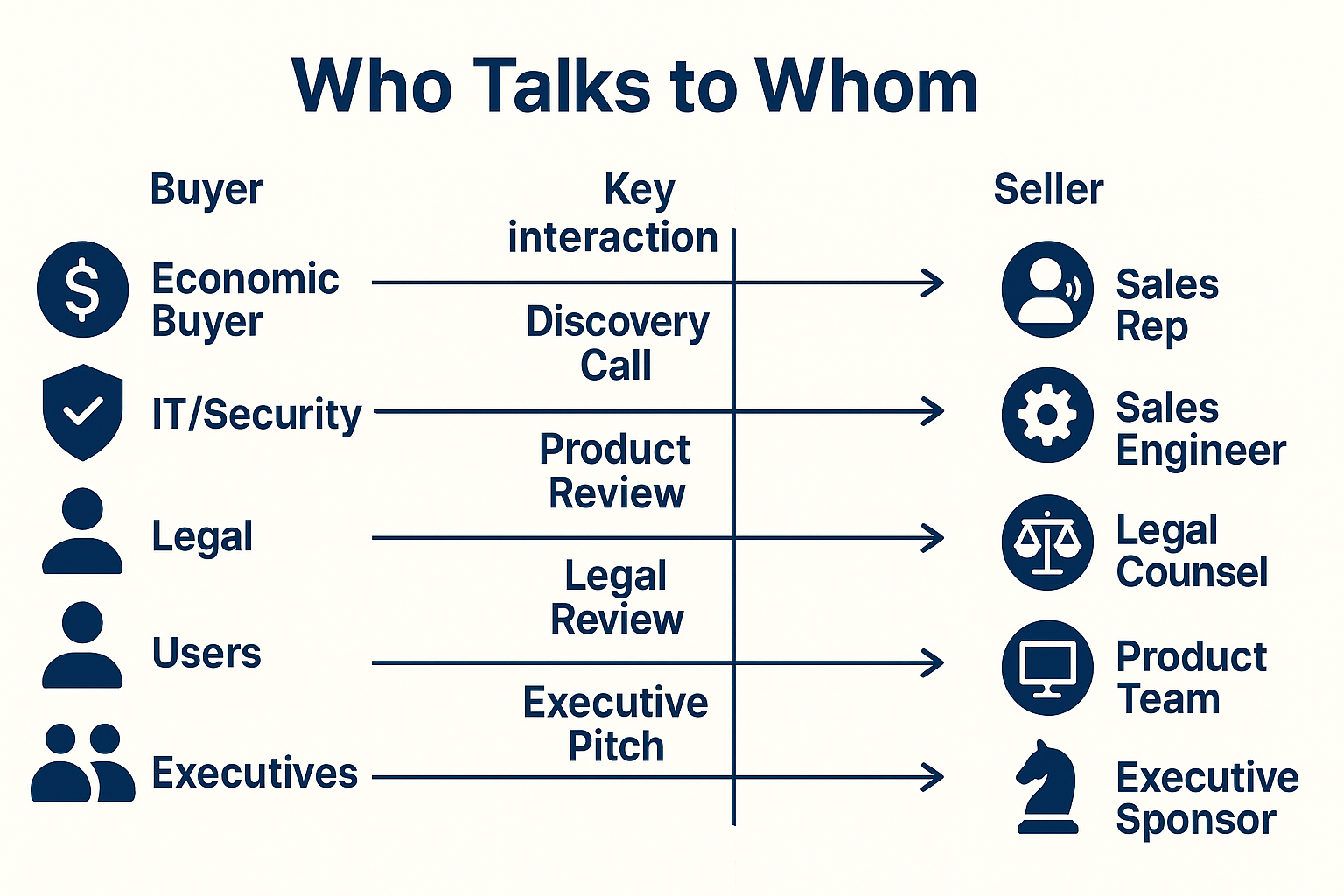
Buying Group — Key Stakeholders
Modern buying committees typically include 6–10 stakeholders. Each plays a unique role in shaping, approving, or blocking a purchase:
Economic Buyer (CFO / Budget Owner) – Controls the budget and signs off on ROI, TCO, and payback timelines.
Champion – Your internal advocate who believes in your solution and pushes it forward internally.
End Users – The people who will actually use the product or service; they focus on usability and fit with their daily workflows.
IT / Security – Evaluates technical architecture, integrations, security posture, and compliance.
Legal – Reviews contracts, DPAs, and ensures risk mitigation.
Procurement – Manages commercial terms, vendor onboarding, and compliance with company purchasing policies.
Executive Sponsor – Senior leader who provides political air cover, strategic alignment, and final approval if needed.
Each of these stakeholders evaluates your solution from a different lens. If even one group is unconvinced, the deal can stall.
Selling Team — Core Roles
On the selling side, it’s equally important to bring the right people into the conversation at the right time:
SDR / BDR (Sales or Business Development Reps) – Responsible for outbound prospecting and qualifying inbound leads before handing them off.
AE (Account Executive) – Owns the deal, runs discovery, demos, and commercial conversations.
SE / Solutions Consultant – Provides deep technical expertise, handles integrations, and supports complex demos.
Deal Desk / CPQ – Ensures pricing, discounting, and approvals are consistent and structured.
Legal & Security – Supports negotiations, contract reviews, and security assessments.
CS / AM (Customer Success / Account Manager) – Takes over post-sale to drive onboarding, adoption, and expansion.
Why This Mapping Matters
Deals close faster when each buyer role is met with the right seller role at the right stage. For example:
Security buyers should talk to your security lead, not just an AE.
Executive sponsors on the buyer side should hear from your leadership or senior AE, not a cold email.
Champions should be equipped with clear business cases, security FAQs, and integration maps to win internal support.
Qualification & Forecasting (Frameworks You Can Copy)
Great B2B sales teams don’t rely on “gut feel” to decide which deals to pursue or how much revenue they’ll close. They use structured qualification frameworks to assess opportunities early and clear forecasting methods to predict outcomes accurately. This is where discipline separates top performers from guesswork.
Qualification Frameworks (Compare & Choose)
Different frameworks suit different deal types. Here’s a breakdown of the most widely used ones, plus when to apply each.
MEDDICC
Best for: Enterprise, multi-stakeholder, complex sales cycles.
What it focuses on:
Metrics — Quantifiable business impact
Economic Buyer — Budget owner and sign-off power
Decision Criteria — How they evaluate solutions
Decision Process — Steps, people, timelines
Identify Pain — Clear business problems to solve
Champion — Internal advocate driving the deal
Competition — Who else is being evaluated
Why it works: Forces deep stakeholder mapping and ROI alignment early.
Common pitfall: Teams collect surface-level info without actually verifying it with the buyer.
SPICED
Best for: Modern SaaS sales, mid-market and enterprise.
What it focuses on:
Situation — Current state
Pain — Problems and blockers
Impact — Consequences of not solving them
Critical Event — Timeline or trigger driving urgency
Envisioned Future — Desired outcomes
Decision — Buying process and stakeholders
Why it works: It’s conversational, outcome-driven, and well suited to consultative sales.
Common pitfall: Skipping the “critical event,” which often leads to stalled deals later.
BANT
Best for: High-volume inbound or transactional deals.
What it focuses on:
Budget — Do they have funds?
Authority — Who decides?
Need — Is there a real problem?
Timeline — When will they act?
Why it works: Simple and quick for early qualification.
Common pitfall: It’s too shallow for complex deals; over-reliance can lead to misjudged enterprise opportunities.
How to Choose:
Use BANT for quick triage on inbound or SMB leads.
Use SPICED for SaaS mid-market/enterprise deals that need consultative conversations.
Use MEDDICC for complex, multi-threaded enterprise sales where ROI and stakeholder mapping are critical.
Many teams blend frameworks — for example, BANT for initial screening and MEDDICC as deals progress.
Forecasting the Right Way
Accurate forecasting isn’t just about numbers; it’s about defining clear exit criteria for each stage and continuously assessing opportunity health.
Stage Definitions & Exit Criteria
Each sales stage (e.g., Discovery, Evaluation, Proposal, Commit) should have specific, observable criteria for progressing.
Example: Moving to “Proposal” requires confirmed decision criteria, identified economic buyer, and validated pain — not just “they liked the demo.”
Opportunity Health Signals
Healthy opportunities show specific buyer behaviors and engagement patterns. Here’s a simple table your team can use:
Signal | Why It Matters | How to Verify |
|---|---|---|
Stakeholder Coverage | Deals with multiple engaged roles are less likely to stall | Map buying group in CRM; check activity with each stakeholder |
Compelling Event | Creates urgency and drives internal alignment | Ask directly: “What happens if this slips?” Document in notes |
Mutual Action Plan (MAP) | Keeps both sides accountable to milestones and timelines | Create a shared MAP and track progress weekly |
Verified Decision Process | Reduces surprises at the end | Confirm legal, security, procurement steps and timeline with the buyer |
Economic Buyer Engagement | If they’re not engaged, the deal isn’t real | Confirm meetings or sign-off conversations with the budget owner |
Forecast Categories
Commit — Deals with verified decision process, engaged economic buyer, and mutual plan in place.
Best Case — Promising deals with strong signals but lacking final validation.
Pipeline — Early-stage opportunities with incomplete qualification.
Why this matters:
Good forecasting gives leadership confidence, prevents overcommitting, and highlights where deals need coaching — long before quarter end.
Practical Tip:
Pick one qualification framework and one forecasting structure, train the team rigorously, and enforce stage exit criteria in your CRM. Consistency beats complexity every time.
Messaging & Proof That Win Committees
In B2B sales, you’re not just convincing a single person — you’re convincing a committee of stakeholders, each with their own priorities. A winning sales motion speaks fluently to every lens the committee uses to evaluate a solution, and backs that message with hard evidence, not hype.
The most effective way to structure your message is around four core value pillars. Each pillar aligns with a different set of stakeholder concerns and should be reflected in both your narrative and your sales assets.
The Four Value Pillars
Pillar | Focus | Primary Stakeholders | What They Care About |
|---|---|---|---|
Financial | ROI, TCO, cost savings, efficiency gains | CFO, economic buyer, procurement | Clear financial justification, payback periods, budget impact, measurable business outcomes |
Technical | Scalability, integration, performance, future-proofing | IT, product, operations | Architecture fit, API maturity, reliability, compatibility with existing systems, ability to scale |
Risk | Security, compliance, legal exposure | Security, legal, risk officers | Certifications (SOC 2, ISO), data protection, governance, privacy, vendor reliability |
People | Ease of use, adoption, enablement, team impact | End users, managers, department leads | How fast their teams can learn, adopt, and get value; reduction in friction and support burden |
Great messaging weaves these pillars into every conversation and asset, rather than treating them as afterthoughts late in the cycle.
Essential Artifacts to Back It Up
Modern buying committees expect proof up front. The following assets help internal champions make the case inside their organization without needing you in the room:
One-Page Business Case – A concise document connecting the buyer’s goals to the expected business impact.
ROI Model – A customizable financial model showing savings, revenue impact, or efficiency gains over time.
Security FAQ / SOC 2–ISO One-Pager – A clear summary of your security posture, certifications, and data practices.
Integration Map – A visual diagram of how your solution fits into their existing tech stack.
Implementation Timeline – A realistic rollout plan that gives operations and IT confidence.
Executive Brief Deck – A lightweight presentation your champion can circulate internally to senior leadership.
A Practical Tip
Publish a public Trust & Compliance Center on your website.
Housing your certifications, security summaries, subprocessors list, DPIAs, and FAQs in one place dramatically shortens legal and security reviews later. It also builds credibility early in the sales cycle — before procurement even starts asking questions.
Legal, Security & Procurement — Navigating the Gate
Even the most enthusiastic buying committee can hit a wall if legal, security, or procurement teams raise concerns late in the cycle. These groups act as gatekeepers, protecting their organization from risk. How well you prepare for this stage often determines whether a deal closes smoothly or gets stuck in review loops for weeks.
Top sales teams treat this stage as part of their core sales process, not a final hurdle.
What to Prepare in Advance
Having the right documents and answers ready before legal and security teams ask dramatically speeds up approval cycles. Here’s what you should have on hand for every deal:
DPIA Summary – A clear explanation of how data is collected, stored, processed, and protected.
DPA (Data Processing Addendum) – Standard contractual clauses governing data handling and privacy.
Subprocessors List – Transparent list of third parties involved in data processing, with locations and roles.
Data-Flow Map – A simple, visual diagram showing how data moves through your systems.
RBAC/SSO Documentation – Proof that your platform supports role-based access control and secure authentication.
Penetration Test Summary – Executive summary of third-party security assessments, showing issues and resolutions.
Insurance Certificates – Proof of coverage (e.g., cyber liability, errors & omissions).
Order Forms & MSA Exhibits – Clear, standardized contracts that legal teams can review quickly.
Having these prepared and standardized also gives your champions confidence—they can bring their legal and security teams into the loop early without surprises.
Deal Desk / CPQ Controls
Legal and commercial alignment is just as important as technical prep. A structured deal desk or CPQ (Configure, Price, Quote) process ensures every deal follows clear rules:
Discount Guardrails – Set maximum discount thresholds by deal size or segment to avoid last-minute escalation.
Approval Matrix – Define who must sign off on legal, security, commercial, or pricing exceptions.
Non-Standard Terms Playbook – Pre-agreed guidance on how to handle unusual contract terms, data requests, or redlines.
This infrastructure turns chaotic last-minute approvals into predictable workflows — essential for clean quarter closes.
Security Review Checklist
A quick internal checklist to keep deals moving:
DPIA summary shared with buyer’s security team
DPA template provided early
Subprocessors list reviewed
Data-flow diagram attached
Security certifications and pen-test summary delivered
RBAC/SSO documentation shared
Insurance certificates attached
Order form and MSA ready for legal review
Digital Sales Rooms (DSR) & Mutual Action Plans (MAP)
Enterprise deals are rarely won through a single email thread or a shared folder. Multiple stakeholders get involved, assets fly back and forth, and timelines stretch if there’s no clear structure. That’s where Digital Sales Rooms (DSRs) and Mutual Action Plans (MAPs) come in.
Top-performing teams use these tools to organize complex deals, keep all parties aligned, and shorten the path to signature.
Why Digital Sales Rooms Increase Velocity
A Digital Sales Room is a shared, secure microsite or portal where all deal-related content, timelines, and contacts live. Instead of scattered attachments and long email chains, both sides work from a single source of truth.
Key Advantages:
Centralized assets — proposals, demos, legal docs, security FAQs, pricing, and reference material in one place.
Clear visibility — both seller and buyer see progress, outstanding items, and next steps.
Stakeholder alignment — late-stage decision makers can catch up quickly without extra calls.
Faster cycles — fewer delays caused by “lost” information or internal misalignment.
Well-designed DSRs often contain:
Overview and value summary
Key documents (business case, security docs, legal templates)
Timelines and MAP milestones
Contact list for both teams
Optional video walkthroughs or executive recaps
Mutual Action Plans: Structure and Sections
A Mutual Action Plan (MAP) is a shared timeline and set of responsibilities agreed upon by both seller and buyer. It clarifies what needs to happen, who owns it, and when it will be done — reducing surprises late in the deal.
Core Sections of a MAP:
Milestones — Key steps from now through go-live (e.g., demo, security review, legal sign-off, contract execution, onboarding).
Owners — Named individuals from both buyer and seller responsible for each milestone.
Dates — Realistic, agreed-upon deadlines for every step.
Risks or Dependencies — Identified blockers that could affect timelines, plus mitigation strategies.
Sign-Offs — Final approvals from legal, security, procurement, or executives.
MAPs are living documents. The best reps walk through them live during calls and update them collaboratively after each milestone.
Template: Copy-Paste MAP Outline
You can use a simple table or spreadsheet to get started. Here’s a structure that works across most deal types:
Milestone | Owner (Buyer) | Owner (Seller) | Target Date | Status | Risks / Notes |
|---|---|---|---|---|---|
Security review completed | IT / Security Lead | Security Lead | May 10 | In progress | Waiting for DPIA review |
Legal contract finalized | Legal Counsel | Legal Counsel | May 20 | Not started | Redlines expected around data residency |
Commercial approval | CFO / Procurement | Deal Desk | May 25 | Not started | Pending pricing finalization |
Onboarding kickoff | Project Manager | CS / Implementation | June 1 | Not started | Resource alignment required |
Why this matters:
Using DSRs and MAPs changes the tone of late-stage deals. Instead of chasing updates, you’re collaborating with the buyer on a shared plan. This creates transparency, builds trust, and prevents last-minute surprises that derail forecasts.
Tech Stack for B2B Sales (What You Actually Need)
Modern B2B sales isn’t just about hustle — it’s powered by a well-designed tech stack that gives reps leverage without overwhelming them with tools they’ll never use. The goal isn’t to have the most software, but to build a stack that supports every stage of the sales cycle, from first touch to closed deal.
Core Tools
These are the non-negotiables for most B2B sales teams. They help structure workflow, track pipeline, and keep deals moving efficiently.
CRM (Customer Relationship Management)
The single source of truth for accounts, contacts, opportunities, activities, and forecasting. Everything flows through here.SEP (Sales Engagement Platform)
Powers outbound sequences, task management, and multichannel outreach (email, calls, LinkedIn, video). Ensures consistency and follow-up discipline.CI / Call Recording Platform
Captures conversations for note-taking, coaching, and analysis. Useful for reviewing key calls, onboarding new reps, and spotting patterns.Scheduling Tool
Removes friction by letting prospects book time directly. A small tool that dramatically improves response rates and shortens cycles.Digital Sales Room (DSR)
A shared online space to centralize deal assets, timelines, and stakeholders. Replaces endless email chains with a single source of truth.CPQ & E-Signature
Configure-Price-Quote tools paired with e-signing streamline pricing approvals, proposals, and contract execution — crucial for keeping deals on forecast.
Data & Intent Layer
Beyond the core, the data and intent layer helps your team know who to target, when to engage, and what matters to them.
Data Enrichment
Fills in firmographics, technographics, and contact details so reps spend less time researching and more time selling.Buyer Intent Platforms
Detects signals such as relevant search activity, content consumption, or category interest — helping prioritize accounts already in market.Website De-Anonymization
Identifies which companies are visiting your site, even if they don’t fill out a form. Great for routing warm accounts to outbound.Review Sites & Marketplaces
Platforms like G2, TrustRadius, or AWS Marketplace act as late-stage validation hubs. Buyers use them to compare vendors and verify credibility before making decisions.
AI in 2026
AI is no longer a “nice to have” — it’s becoming a quiet co-pilot across the sales cycle. But it works best when it augments humans, not replaces them.
Where AI adds value today:
Research Summaries — Quickly consolidates account, industry, or persona data for pre-call prep.
Call Notes & Action Items — Automates note-taking during calls, then pushes structured summaries to CRM.
Sequence Drafting — Suggests tailored email or LinkedIn outreach sequences based on ICP and trigger events.
Coaching Prompts — Surfaces feedback for reps based on real conversations, helping managers coach at scale.
Key Principle: Keep human approval in the loop. AI suggestions should always flow back into the CRM to maintain visibility, compliance, and quality.
Putting It All Together
A lean but powerful B2B sales stack looks something like this:
CRM at the center, connected to SEP and CI tools for execution, DSR and CPQ for closing, data/intent platforms for prioritization, and AI tools layered in to handle research, summarization, and coaching.
The result: less manual work, faster deal cycles, and cleaner pipeline visibility — without tool sprawl.
Metrics & Dashboards (Sales-Side)
The best B2B sales teams run on clear, layered metrics, not vanity dashboards. Instead of chasing raw activity numbers, they focus on pipeline quality, conversion health, and revenue outcomes. The goal is simple: give each level of the organization the right data to make better decisions — nothing more, nothing less.
Core Sales Metrics to Track
These are the fundamental numbers that tell you if your sales engine is working. They focus on outcomes, not just inputs:
Pipeline Created — Total value of opportunities generated within a specific period.
Average Selling Price (ASP) — Average deal size, tracked by segment and motion.
Win Rate — Percentage of qualified opportunities that close. A leading indicator of positioning, enablement, and process quality.
Sales Cycle Length — Average number of days from opportunity creation to close. Shorter cycles usually mean better alignment and less friction.
Forecast Accuracy — The gap between forecasted revenue and actuals. Healthy teams maintain a tight variance.
Quota Attainment — Percentage of reps hitting or exceeding their targets. A pulse check on team performance and process scalability.
Net & Gross Revenue Retention (NRR / GRR) — Indicators of expansion, churn, and overall revenue health after initial deals are closed.
Important:
Activity metrics (calls made, emails sent, meetings booked) are directional — they support performance, but they’re not the goal. Always tie them back to pipeline and revenue outcomes.
Dashboards by Level
Not everyone needs the same data. A strong dashboard strategy separates signal from noise by role:
Executive Dashboard
Audience: CRO, VP Sales, leadership
Focus: Business outcomes
Pipeline created vs. targets
Bookings vs. forecast
Win rates and ASP trends
NRR/GRR performance
Forecast accuracy over time
Manager Dashboard
Audience: Frontline sales managers
Focus: Conversion health and coverage
Stage-by-stage conversion rates
Pipeline coverage vs. quota (e.g., 3x rule)
Deal velocity and bottlenecks
Rep attainment pacing
Rep Dashboard
Audience: AEs, BDRs, sellers
Focus: Next actions and ownership
Current pipeline by stage
Tasks, follow-ups, and MAP deadlines
Personal attainment pacing
Deal health indicators (stakeholder coverage, timelines, risk flags)
RevOps Dashboard
Audience: Sales operations, systems teams
Focus: Data quality and process reliability
CRM hygiene and data completeness
SLA adherence on handoffs and follow-ups
Stage exit criteria compliance
Forecast category consistency
Why This Matters
Good dashboards align behavior with outcomes.
Reps know what to focus on next.
Managers can coach where it matters.
Leadership gets clarity, not surprises.
RevOps can keep the machine clean and scalable.
When everyone’s looking at the right view for their role, forecasts tighten, pipeline becomes healthier, and sales cycles move faster.
Territory, Compensation & Governance
A strong sales strategy isn’t just about how you sell — it’s also about how you organize, incentivize, and control your go-to-market engine. Territory planning, compensation structures, and governance rules set the foundation for predictable performance, fair coverage, and scalable operations.
Territory Models
The way you carve up your market directly impacts rep focus, coverage, and deal velocity. There’s no one-size-fits-all — the best model depends on your segment, ACV, and team maturity.
Geographic Territories
Reps own specific regions (e.g., North America, EMEA, APAC).
Best for: Large addressable markets, international expansion, or when local presence matters.
Vertical Territories
Territories are split by industry (e.g., financial services, manufacturing, healthcare).
Best for: Companies with strong industry specialization or tailored messaging per vertical.
Named Accounts
Each rep gets a fixed list of strategic accounts.
Best for: Enterprise sales where deal cycles are long and accounts are few but high-value.
Hybrid Models
Combine multiple approaches — for example, named strategic accounts plus geographic coverage for mid-market.
Best for: Scaling companies balancing focus on whales with broad market reach.
Tip: Keep territory rules clear and stable. Constant reshuffling erodes pipeline momentum and rep trust.
Compensation Basics
Compensation drives behavior. A clear, fair, and motivating plan aligns rep incentives with company goals.
OTE Mix (On-Target Earnings)
Typically a 50/50 or 60/40 split between base and variable for AEs, depending on segment and role complexity.
Accelerators
Higher commission rates for deals beyond 100% of quota. They reward overperformance and push strong reps to exceed targets.
Clawbacks
Protect the company against churn or deals that fall through after booking. Common in long implementation cycles or multi-year contracts.
SPIFs (Sales Performance Incentive Funds)
Short-term, targeted incentives to drive specific behaviors (e.g., selling a new product line, closing by quarter-end, booking more meetings in a new region).
Key Principle: Simplicity wins. Comp plans that are too complex cause confusion and misaligned behavior.
Governance
Governance creates structure and control around how deals move through the pipeline and how commercial decisions are made. This keeps the system fair, predictable, and scalable as the team grows.
Stage Exit Criteria
Clear, objective requirements for moving deals between stages. Prevents “happy ears” forecasting.
Approval Flows
Defined sign-off paths for legal, security, pricing, and non-standard terms. No deal should rely on ad hoc escalation.
Pricing Guardrails
Pre-set rules around discounting, deal structures, and exceptions. Reduces last-minute chaos and preserves margins.
Discount Policy
Establishes maximum allowable discounts by segment or deal size, plus escalation paths for exceptions.
Why This Matters
When territories are fair, comp plans are aligned, and governance is clear, sales teams run with focus and confidence. Reps know where to hunt, how they’ll be rewarded, and which rules keep deals moving cleanly. Leadership gets predictability; reps get clarity. That’s the backbone of scalable revenue.
B2B Sales Playbooks
While every sales team develops its own nuances over time, certain core motions repeat across segments. Below are three battle-tested playbooks you can use as templates — one for outbound enterprise, one for mid-market inbound, and one for expansion/renewals. They’re designed to be clear, structured, and easy for reps to execute consistently.
Outbound Enterprise
Best for: High-ACV deals, strategic accounts, complex buying committees.
Playbook Flow:
ICP List – Build a curated list of high-fit accounts using firmographics, technographics, and intent signals. Prioritize based on strategic importance and potential deal size.
Trigger / Intent – Identify signals that show buying readiness: job changes, funding rounds, hiring patterns, review site activity, technology changes.
Multithreaded Sequence – Engage multiple stakeholders (economic buyer, champion, IT/security, end users) through coordinated outreach across channels. Avoid single-threading.
Discovery – Run a deep discovery session to diagnose pain, align on impact, and map decision criteria.
Mutual Action Plan (MAP) – Co-create a timeline and responsibilities to keep the deal structured through evaluation, legal/security review, and close.
Why it works: Strategic accounts rarely come inbound. A structured, multithreaded outbound motion gives you control over targeting and pace while creating early alignment with all key stakeholders.
Mid-Market Inbound
Best for: SaaS or B2B solutions with inbound demand, shorter cycles, and faster decision-making.
Playbook Flow:
Comparison / Pricing Pages – Optimize these pages for conversion. Many buyers land here first — they should clearly show value, tiers, and CTAs.
Fast Lane Routing – Get high-intent leads (e.g., pricing page visitors, demo requests) directly to AEs or fast SDR follow-up — ideally within minutes, not hours.
Tailored Demo – Focus on the 2–3 problems they care about most. Show integrations and outcomes, not feature tours.
Business Case – Quickly package a one-pager or ROI summary for internal circulation.
Close – Lean on standard contracts, security FAQs, and fast procurement to keep deals from stalling.
Why it works: Mid-market buyers prefer to self-educate, then move fast. This playbook removes friction and aligns your sales motion with their buying pace.
Expansion / Renewal
Best for: Existing customers approaching renewal or with untapped expansion potential.
Playbook Flow:
Adoption Review – Evaluate product usage, adoption metrics, and outcomes. Identify gaps or underutilized features.
Value Recap – Document wins since implementation: ROI achieved, pain points solved, business impact delivered.
Success Plan – Co-create a roadmap for the next phase of impact: new use cases, features, or teams to onboard.
Cross-Sell Pilot – Offer a low-friction, time-boxed pilot to test additional modules, integrations, or services.
Why it works: Renewals and expansions rely on proof, not persuasion. When you lead with evidence of value and a clear plan for the future, upsells and renewals become natural next steps — not hard sells.
Why These Playbooks Matter
Playbooks give your team repeatable structures they can follow without reinventing the wheel on every deal. Reps can adapt them to fit context, but the core steps stay consistent — which means better forecasting, cleaner handoffs, and faster deal cycles.
Industry-Specific Examples (“Show Your Work”)
No matter what you sell, modern B2B buyers expect to see proof early—not just hear promises during a demo. The most effective teams build public, self-serve asset libraries tailored to their industry and go-to-market model. This lets champions educate internal stakeholders, accelerates evaluations, and builds trust long before procurement steps in.
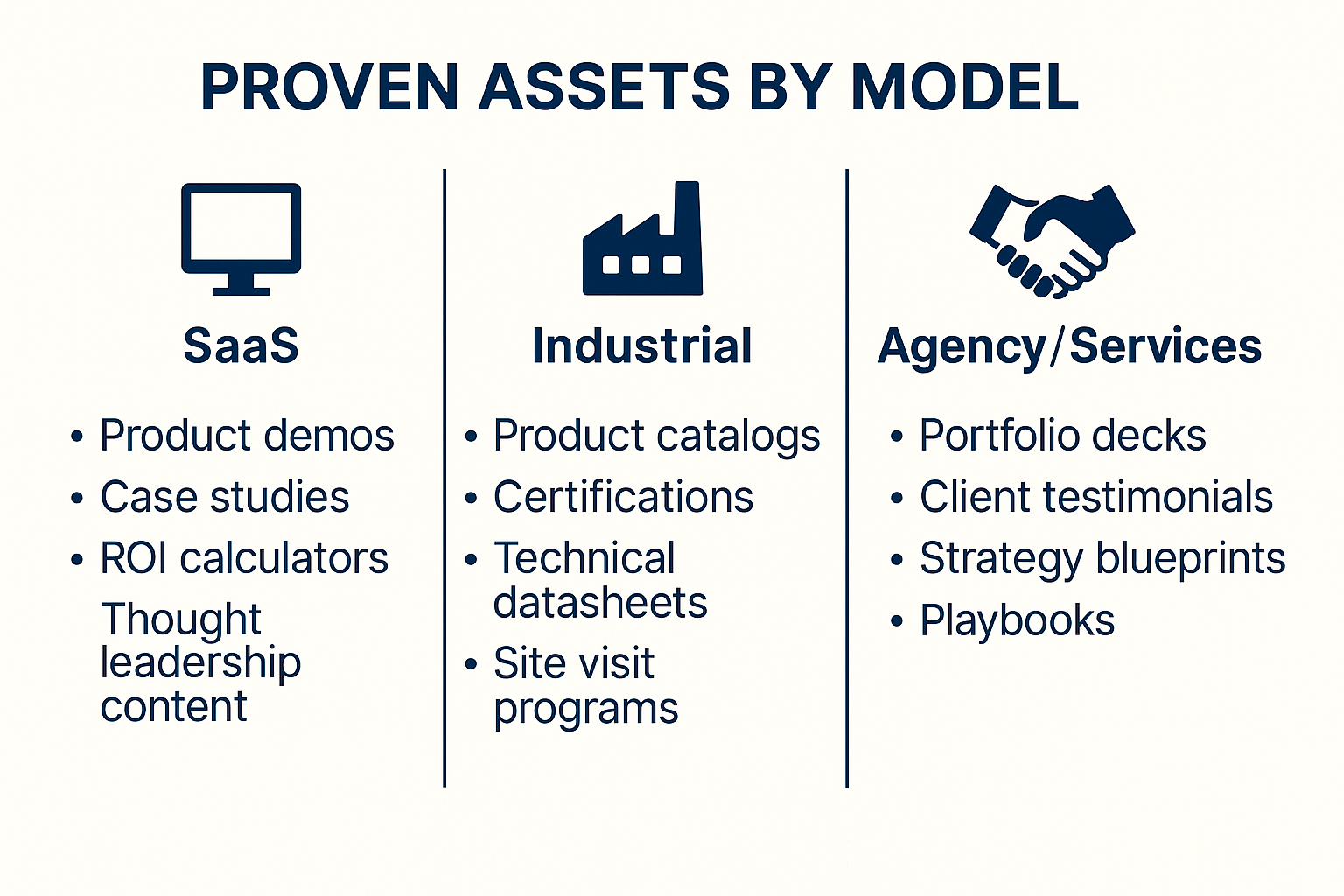
Here are three proven models to learn from:
SaaS
Why it matters: SaaS buyers typically run structured evaluations across multiple vendors. They care about pricing clarity, security posture, and financial justification early in the process.
Key Assets to Build:
Comparison & Pricing Hubs – Central pages that clearly outline pricing tiers, feature differences, and “X vs Y” comparisons for competitor alternatives.
Public Security & Trust Center – SOC 2 / ISO summaries, DPIAs, data flow maps, legal FAQs — all accessible without an NDA.
ROI Calculator or TCO Model – Interactive tools or downloadable spreadsheets that quantify the business impact of choosing your product.
Result: Buyers move through their evaluation faster, champions have ready-to-share assets, and legal/security reviews don’t become late-stage blockers.
Industrial
Why it matters: Industrial buyers rely on technical validation, operational performance data, and clear documentation. Purchasing decisions often involve engineers, procurement, and plant managers.
Key Assets to Build:
Application Notes – Real-world use cases showing how your products solve specific problems in the field.
Maintenance & Performance Calculators – Tools that help estimate lifecycle costs, efficiency gains, or downtime reductions.
Multi-Language Spec Sheets – Standardized PDFs covering specs, tolerances, certifications, and compliance, translated for global teams.
Result: Engineers and procurement teams get the detail they need upfront, reducing back-and-forth and speeding up technical approvals.
Agency / Services
Why it matters: Service buyers want evidence of past results, pricing transparency, and a safe way to start. Trust is the deciding factor.
Key Assets to Build:
Vertical Case Studies – Detailed success stories organized by industry, showcasing measurable outcomes.
Transparent Tiered Pricing – Clear packaging of service levels, inclusions, and starting price ranges.
Packaged Pilots – Fixed-scope, low-risk engagements (e.g., audits, workshops, short-term pilots) that let prospects experience your work before committing to larger retainers.
Result: Prospects can self-qualify, understand expected value, and engage faster without endless custom proposals.
2026 Trends That Actually Matter
B2B sales is evolving fast, but not every “trend” you hear about is worth your attention. The noise is high; the signal is simple. These are the shifts that are genuinely changing how deals are sourced, shaped, and closed in 2026 — and smart teams are already adapting.
1. Buyer Self-Education and Transparent Expectations
Buyers now do the majority of their research before ever talking to sales. They expect pricing clarity, contract transparency, and evidence upfront—not after a discovery call.
What this means:
Pricing pages, security information, and product comparisons must be easy to find and frictionless to access.
Champions expect to arm themselves internally with ready-made business cases, not generic decks.
Vendors who hide pricing or force gated “book a demo” loops risk losing serious buyers early.
Bottom line: The buying process is happening with or without you. Your content, pricing, and trust signals either accelerate it—or you’re invisible.
2. Short-Form Video and Live Formats Are Dominating LinkedIn
Decision-makers increasingly spend time on LinkedIn not just for networking, but for consuming short, high-value content. Short-form video (30–90 seconds) has become one of the fastest ways to build credibility and spark interest, while podcasts and live series deepen relationships with niche audiences.
What this means:
SMEs and sales leaders should post regularly, not just the brand page.
Native, authentic videos outperform overproduced clips.
Repurposing webinars into short clips creates a steady content stream that reaches buyers where they already are.
Bottom line: LinkedIn isn’t just a social network anymore — it’s a distribution engine for thought leadership and top-funnel awareness.
3. AI-Assisted Personalization Becomes Standard
AI is increasingly handling the repetitive but critical work behind sales motions: research summaries, tailored sequences, call notes, and coaching prompts. The teams that win are using AI to augment, not replace, human sellers.
What this means:
Reps walk into calls with richer context and personalized messaging at scale.
Managers get coaching signals faster.
Outreach becomes sharper and more relevant without ballooning headcount.
Bottom line: AI is shifting from “shiny add-on” to “baked-in co-pilot.” Teams that don’t integrate it will lag behind.
4. Mobile-First Sales Experiences
Decision-makers are consuming content, reviewing materials, and even joining demos on mobile. Yet many vendors still rely on clunky desktop-only experiences.
What this means:
Landing pages, pricing hubs, and content libraries must be optimized for scrolling and tapping.
Vertical video, clean layouts, and minimal friction are key.
Demos and sales assets should work seamlessly on mobile, not break the moment someone opens them on their phone.
Bottom line: If your buying experience isn’t mobile-friendly, you’re adding invisible friction to every deal.
5. Budgets Skew Toward ROI and Conversion
Tighter budgets mean companies are scrutinizing every line item. Fancy tools or campaigns that don’t clearly impact pipeline, win rate, or retention are the first to go.
What this means:
Your commercial story must clearly show business outcomes.
Channels that can’t demonstrate ROI or pipeline contribution will be deprioritized.
Tools and motions that directly shorten cycles or increase conversion get funded first.
Bottom line: Sales motions in 2026 are measured by impact, not noise.
Common Pitfalls & Anti-Patterns
Even experienced teams fall into patterns that quietly erode pipeline quality and deal velocity. Avoiding these mistakes can be just as powerful as adopting new strategies. Here are the most common traps that stall B2B sales cycles — and how to steer clear of them.
1. Treating All Leads Equally
Not every lead deserves the same time and energy. Failing to segment by fit and intent leads to bloated pipelines and wasted AE cycles.
Better: Tier accounts using ICP criteria and buying signals. Prioritize high-fit, high-intent leads for human touch and let automation handle the rest.
2. Single-Threading Deals
Relying on one contact — even a strong champion — is risky. Deals often stall when that person goes on leave, loses influence, or faces internal pushback.
Better: Multi-thread early. Engage economic buyers, security, legal, and end users in parallel. Use a Mutual Action Plan to keep everyone aligned.
3. Demoing Features Without a Business Case
Jumping straight into a product tour without connecting it to the buyer’s business outcomes wastes attention and lowers close rates.
Better: Start with discovery. Tie your demo to 2–3 critical problems they’ve voiced, and close with ROI or impact evidence, not just functionality.
4. Skipping Security & Legal Until Late
Leaving security reviews and legal redlines to the end creates avoidable delays. These teams often have their own timelines, and a late handoff can kill deals at the finish line.
Better: Share DPIA, security FAQs, and legal templates early. Involve your deal desk or legal team at the first sign of procurement interest.
5. Forecasting on Sand
Relying on gut feel or inconsistent stage definitions makes forecasting unreliable. Deals slip unexpectedly, and leadership loses confidence in the pipeline.
Better: Use clear stage exit criteria, track opportunity health signals, and implement a forecasting framework that everyone follows consistently.
6. Chasing Activity Over Outcomes
More calls ≠ more pipeline. Measuring reps solely on activity encourages busywork rather than meaningful engagement.
Better: Track activity, but manage to outcomes: pipeline created, win rates, velocity, and forecast accuracy. Activity should support these, not replace them.
See Also: What is B2B Marketing?
Frequently Asked Questions
What is B2B sales with an example?
B2B (business-to-business) sales is when one business sells products or services to another.
Example: A SaaS company selling payroll software to a finance team, or a manufacturer selling industrial components to an automotive company.
What is the difference between B2B and B2C sales?
B2B sales involve multiple stakeholders, longer cycles, larger deal sizes, and formal evaluations.
B2C sales are typically faster, driven by individual decisions, emotions, and convenience.
B2B selling focuses on ROI, risk mitigation, and organizational impact, while B2C focuses on personal benefits and impulse.
What are the four types of B2B sales?
Producers – Businesses that use goods/services to produce their own offerings.
Resellers – Distributors, wholesalers, or retailers that resell to others.
Governments – Public-sector organizations procuring for public services.
Institutions – Nonprofits, hospitals, schools, and similar organizations.
What are the key stages in the B2B sales process?
Typical stages include:
Targeting & research
Prospecting & qualification
Discovery & diagnosis
Solutioning & demo
Business case development
Evaluation & proof
Negotiation & close
Onboarding & expansion
Each stage requires different messaging, assets, and stakeholder engagement.
What is B2B vs B2C in marketing and sales?
B2B focuses on building long-term relationships, ROI-driven messaging, and consensus across buying committees.
B2C focuses on mass reach, emotional triggers, and fast purchase decisions. The underlying principles overlap, but tactics and cycles are very different.
What is CRM in B2B sales?
CRM (Customer Relationship Management) is the system of record for all account, contact, opportunity, and pipeline data. It tracks every interaction across the sales process, enabling forecasting, handoffs, and collaboration between sales, marketing, and customer success.
How is AI changing B2B sales in 2026?
AI is now embedded across the sales cycle:
Summarizing account research
Generating outreach sequences
Capturing call notes and next steps
Surfacing coaching prompts
Improving forecast hygiene
The key is human oversight. AI accelerates workflows but reps still own the strategy and relationship-building.
How long is a typical B2B sales cycle?
Sales cycles vary by segment:
SMB / Mid-market: typically 2–8 weeks
Enterprise: often 3–9 months, sometimes longer for regulated industries or complex security reviews.
Cycle length depends on deal size, number of stakeholders, and internal procurement processes.
How do you measure success in B2B sales?
The most important metrics are:
Pipeline created
Win rate
Average selling price (ASP)
Sales cycle length
Forecast accuracy
NRR / GRR for post-sale success
Activity metrics support these outcomes but should never be the end goal.
What are common mistakes in B2B sales?
Treating all leads the same
Single-threading deals
Demoing without business context
Delaying security/legal until late
Forecasting without clear criteria
Over-indexing on activity over outcomes
Avoiding these pitfalls improves both win rates and forecasting accuracy.